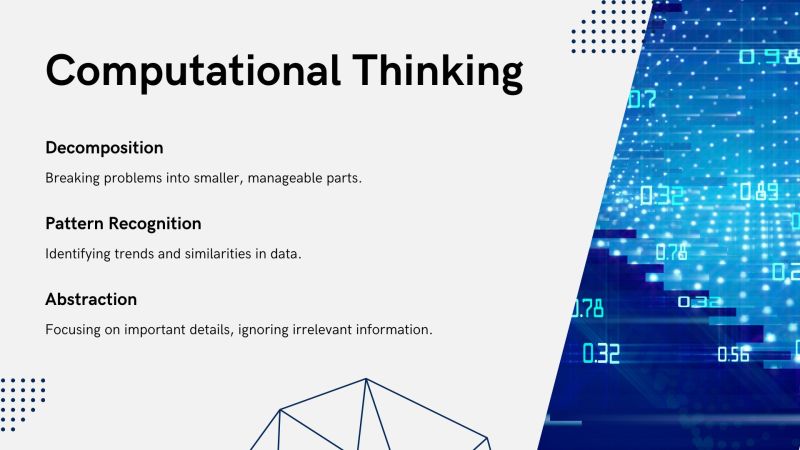
How can organizations build Computational Thinking (CT) across teams – Not just in tech?
In a world driven by A.I., automation, and data, Computational Thinking is no longer just for IT or engineering teams. It’s a strategic mindset every department can benefit from – from marketing to HR, finance to operations.
So how can organizations cultivate CT capacity across their workforce?
🔷 Start with Awareness, NOT code.
CT isn’t about turning everyone into programmers – it’s about building problem solvers. Start by helping teams recognize CT as a way to break down complexity, identify patterns, and design better solutions.
🟢 Integrate CT into existing training.
Whether it’s data literacy, design thinking, or digital transformation programs – embed CT principles into what you’re already teaching. It complements rather than competes with other skills.
🟪 Use Real-World Scenarios
CT becomes powerful when applied to relevant, everyday challenges. Let your marketing team use CT to analyze audience behavior. Let HR use it to streamline recruitment processes. Let finance use it for scenario modeling.
🔺 Encourage a culture of “Test, Learn, Refine”.
CT encourages iteration – model ideas, test quickly, and refine. This mindset helps teams move fast without fear, a trait that A.I.-era businesses need more than ever.
✅ Up-skill Leaders to Think Computationally.
Leadership sets the tone. Equip managers and executives with CT frameworks to enhance strategic thinking, systems design, and A.I. adoption decisions.
CT is not just a skill – it’s a culture.
A culture where teams see problems differently, act decisively, and design smarter, scalable solutions.
And in the age of A.I., that culture is your real competitive advantage!
In my next post, I’ll share practical tools and simple CT exercises that teams can use in everyday work – no coding required.
Follow me to explore how CT can future-proof your workforce.
How can organizations build Computational Thinking (CT) across teams – Not just in tech?